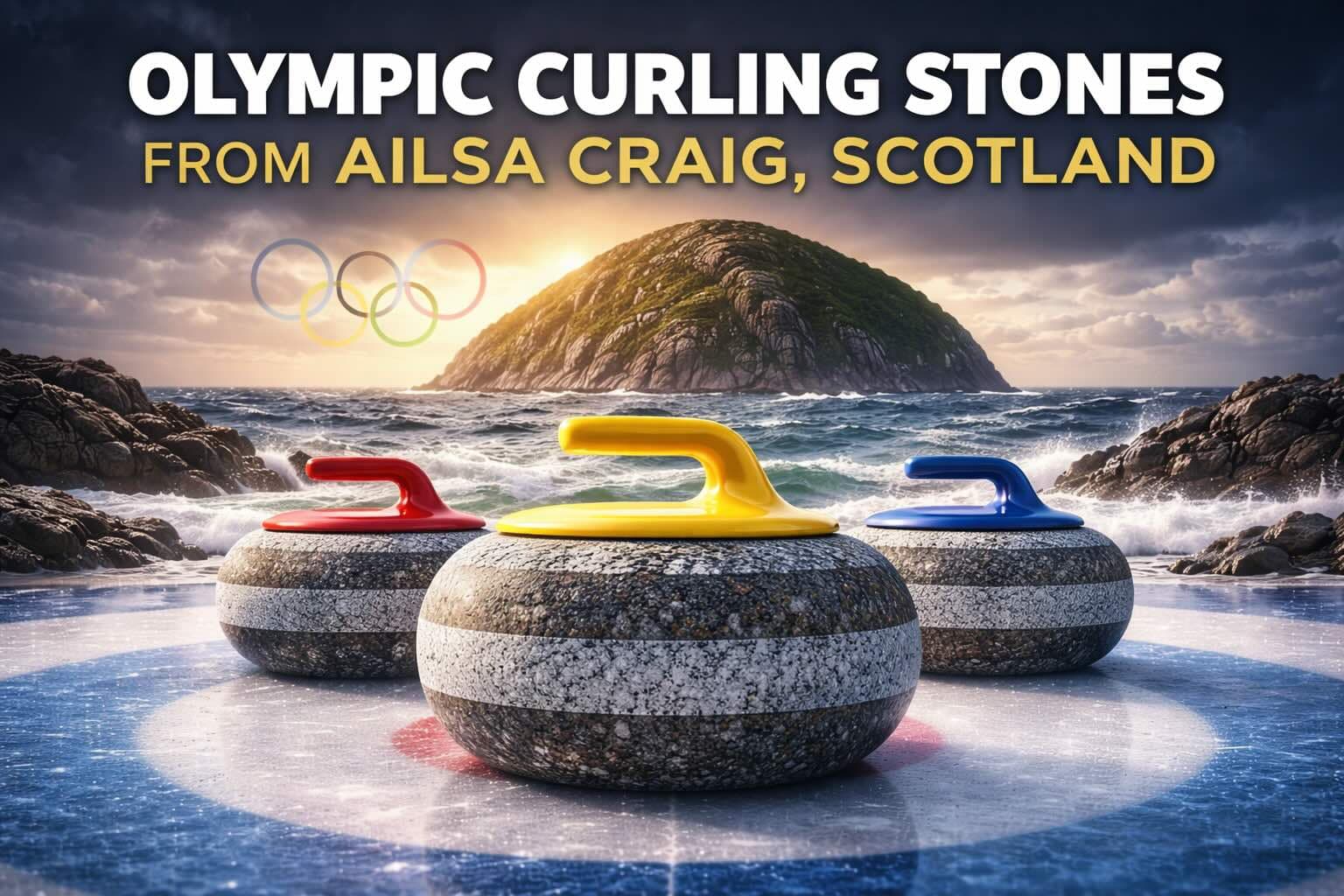
The Winter Olympics are in full swing and curling is one of the sports that captivates audiences around the world. What most viewers do not realise is that every single curling stone on that Olympic ice comes from one place: a tiny, uninhabited volcanic island off the west coast of Scotland called Ailsa Craig.
Every team, every nation, every stone. They are all holding a piece of Scotland.
Plan your journey with Venture Highland
Luxury private tours and chauffeur service from Inverness, designed for Highlands stays, estates, golf, and executive travel.
Planning a day in Inverness, Loch Ness, or a private shore excursion from Invergordon? We’ll tailor the route around your interests.
Ailsa Craig: the island that supplies the world
Ailsa Craig sits in the Firth of Clyde, about 16 kilometres off the Ayrshire coast. It rises 340 metres from the sea, a dramatic volcanic plug visible from much of the south-west Scottish coastline. The island is uninhabited and has been a nature reserve for decades, home to one of the largest gannet colonies in the world, with tens of thousands of nesting seabirds.
But beneath the birds, the island holds something unique: two types of micro-granite that are found nowhere else on Earth and that happen to have the perfect properties for curling stones.
Why Ailsa Craig granite?
Curling stones need granite that absorbs almost no water. When a stone slides across ice, any moisture absorption causes the surface to deteriorate, affecting the curl and the consistency of play. Ailsa Craig granite has the lowest water absorption rate of any granite ever tested.
Two varieties are quarried. Blue Hone is exceptionally dense and is used for the running band, the narrow ring on the base of the stone that actually contacts the ice. Ailsa Craig Common Green is used for the body of the stone. Together they produce a curling stone that is consistent, durable and responsive to the sweeping and turning that makes curling the fascinating game it is.
No other granite in the world matches these properties. Scientists and stone makers have tested alternatives from Wales, Norway and Canada. None come close. Ailsa Craig remains the only source.
Kays of Scotland: the only maker
Kays of Scotland, based in Mauchline in Ayrshire, is the only company in the world that manufactures curling stones from Ailsa Craig granite. They have been doing this since the 19th century. The process involves quarrying the raw granite (now done in limited, carefully managed extractions to protect the island's ecology), cutting, shaping, polishing and fitting each stone with its handle.
Every curling stone used at the Winter Olympics, the World Championships, and the vast majority of competitive curling worldwide is made by Kays. It is a remarkable Scottish export that most people have never heard of.
A brief history of curling in Scotland
Curling originated in Scotland in the medieval period. The earliest written reference dates from 1541, and a curling stone inscribed with the date 1511 was found at the bottom of a pond in Dunblane. The game was played on frozen lochs and ponds across Scotland for centuries before it moved indoors.
The Royal Caledonian Curling Club, founded in 1838 and based in Perth, is the sport's governing body in Scotland and was the international governing body until the World Curling Federation took over in 1966. Curling became a full Olympic medal sport in 1998 at Nagano, though it had appeared as a demonstration sport several times before.
Scotland's national teams have been consistently competitive at world level. The sport remains deeply rooted in Scottish culture, with curling clubs and rinks across the country. When you watch curling at the Olympics, you are watching a game that was born on frozen Scottish lochs and is still powered by Scottish stone.
Visiting Ailsa Craig and Ayrshire
Ailsa Craig is visible from much of the Ayrshire coast, and boat trips run from Girvan when conditions allow. The island is a bird sanctuary, so landings are seasonal and dependent on weather, but the boat trip itself offers stunning views of the island and its seabird colonies.
Ayrshire is also home to some of Scotland's finest links golf courses, including Turnberry, Royal Troon, and Prestwick. A day that combines a boat trip past Ailsa Craig with a round of golf on the Ayrshire coast is hard to beat. See our Ayrshire golf transfers for more.
Scotland's quiet influence on world sport
Scotland gave the world golf. It gave the world curling. And in curling's case, it continues to supply every competitive stone on the planet from a single uninhabited island in the Firth of Clyde. There is something quietly remarkable about that: while nations compete for gold medals, the stones they are throwing are all made in a small workshop in Ayrshire from granite quarried on a bird sanctuary.
Next time you watch curling at the Olympics, remember: every stone on that ice is Scottish. Every team is holding a piece of Scotland.
Frequently asked questions
Why do all curling stones come from Ailsa Craig?
The granite on Ailsa Craig has an exceptionally low water absorption rate, which means the stones do not deteriorate with repeated contact with ice and water. Two types of granite are quarried: Blue Hone for the running surface and Ailsa Craig Common Green for the body of the stone. No other granite in the world matches these properties for curling.
Where is Ailsa Craig?
Ailsa Craig is a volcanic island in the Firth of Clyde, about 16 kilometres off the Ayrshire coast in south-west Scotland. It sits roughly halfway between Glasgow and Belfast and rises 340 metres from the sea. The island is uninhabited and is now a nature reserve, home to one of the largest gannet colonies in the world.
Who makes the curling stones?
Kays of Scotland, based in Mauchline, Ayrshire, is the only company in the world that manufactures curling stones from Ailsa Craig granite. They have been making stones since the 19th century. Every stone used at the Winter Olympics is made by Kays.
Can you visit Ailsa Craig?
Boat trips run from Girvan on the Ayrshire coast, weather permitting. The island is a bird sanctuary managed by the RSPB, so visits are seasonal and dependent on conditions. It is a memorable day trip if the weather cooperates.
How many curling stones does a set include?
A full set for a match is 16 stones, eight per team. Each stone weighs between 17 and 20 kilograms and is polished and fitted with a handle. The running band on the base, the part that contacts the ice, is made from Blue Hone granite.
Related reading
What Americans Should Know About Touring Scotland · Golf Tours and Transfers · Ayrshire Golf Transfers · Scottish Highlands Luxury Travel Guide